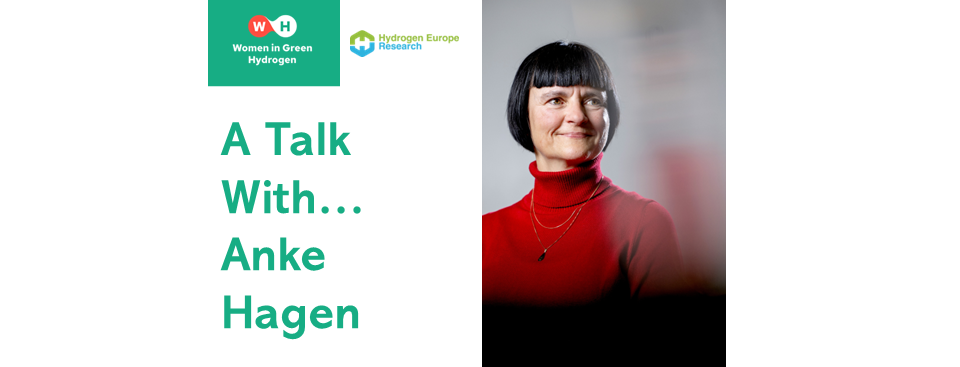
Jointly with our partner Hydrogen Europe Research, we are proud to present a series interviewing women in the green hydrogen sector.
Introducing Anke Hagen
Anke Hagen is a professor at Technical University of Denmark in the Department of Energy Conversion and Storage. She studied chemistry at the University of Leipzig, where she obtained a Dr. rer. nat. (PhD) in heterogeneous catalysis in 1994. After around ten years working in this field, she moved into solid oxide fuel cells and electrolysis research in 2003. In 2018, she received a Dr. techn. degree from DTU, and in 2024 she was appointed Knight of the Order of the Dannebrog.
Throughout her career, her research has taken her to Germany, Japan, the United States, and Denmark, shaping her strong belief in collaboration across disciplines, educational backgrounds, and cultures.
Anke is actively involved in several national and international initiatives, including Hydrogen Europe Research, the Danish Center for Energy Storage, and the International Energy Agency. Over the past 23 years, she has led and contributed to many national and European research projects in the field of hydrogen and energy technologies. Among the projects she coordinated are ECo, Aegir, NewSOC, and NOAH2.
She has published 182 scientific publications, including 123 peer reviewed articles. Alongside her teaching activities at DTU, she is also engaged in public outreach through science festivals and educational events, such as National Science Festivals and People’s University.
Outside of her professional life, Anke has been married for 38 years and has an adult son.
You have been involved in hydrogen research for a long time already – since 2003. How would you describe the development of the sector?
I started my research in the “hydrogen sector”, more specifically in the area of solid oxide fuel cells and electrolysis, in 2003. In the past 23 years, I witnessed a tremendous development, first from pure fuel cell research, followed by increased focus towards electrolysis and power-to-X. The palette of potential applications of these technologies steadily grew opening new opportunities and thus multiplying chances of success. At the same time, more and more industrial players emerged, developing and installing units towards commercial breakthrough. Even though this has been a winding path, with turns and setbacks, I draw a lot of energy from knowing that my research contributes to turning knowledge into a technology that actually benefits society and that I am able to witness this transition.
From your perspective, which are currently the most urgent research topics?
While installations of fuel cell and electrolysis units progress, driven by the need for efficient, low‑carbon energy conversion and storage solutions, research needs to boost further the cost competitiveness. Important focus areas are for example longer lifetime, cheaper & non-critical raw materials and manufacturing technologies, and recycling & re-use. Furthermore, I believe that science must go hand in hand with communication and education. We will only succeed if we move forward together. I truly enjoy sharing my knowledge with the public, the younger generation in particular, engaging in discussions and creating inspiration.
In your early career, you changed universities often due to time-limited contracts – a common occurrence in Germany. What are the advantages and disadvantages for research but also for the researcher of this system?
When I was studying chemistry at the University of Leipzig in the 1980s, I experienced the exciting, inspiring atmosphere of research leading to my decision of pursuing an academic carrier. At the same time, I wanted to establish a family. It turned out that in combination, these two ambitions were difficult to reach. The path was not at all straight, in fact, it meant moving between cities, countries, even continents, short-term working contracts for many years, lack of childcare options, etc., all in a period, where families are typically started and one wants to settle down. I believe these might be reasons why young talents with similar ambitions terminate their pursuit of an academic carrier, probably females to a larger extent. Looking around, I discover many young female students, PhD students, postdocs. However, among professors I am clearly in the minority, the same goes for members in panels or for the scientific degree of Dr. technices, where we are only eight females in the over 100 years history of awarding this degree at DTU, among more than 200 total candidates.
Still today, it is more difficult for mothers (keyword: motherhood penalty) than fathers to have a fulfilling career, but it was even more difficult 10 or 20 years ago. You did it anyway – how did you succeed?
That I succeeded with my ambitions about a family and a carrier despite significant challenges, I can thank my husband Stefan for, in the first place, who supported me and was part of the long journey. Furthermore, I kept my overall ambition, while navigating through opportunities. I focused rather on what was possible, even if it meant to change research field or settling down in a foreign country. I took inspiration from role models along the way and that is what I want to share actively with the next generation.
What guidance would you give to young professionals — and especially young women — who are just starting out in the hydrogen and clean energy sector?
The overall topic of “hydrogen” with all its many facets is truly exciting. It offers the chance to contribute to society moving towards a better future. There are numerous challenges to solve, scientific, technological, and societal. Being part of this journey requires curiosity, endurance, and creativity. Be prepared to adjust your paths and do not fear to deviate from them. Sometimes, the most rewarding accomplishments lie off the main path.