Jointly with our partner Hydrogen Europe Research, we are proud to present a series interviewing women in the green hydrogen sector.
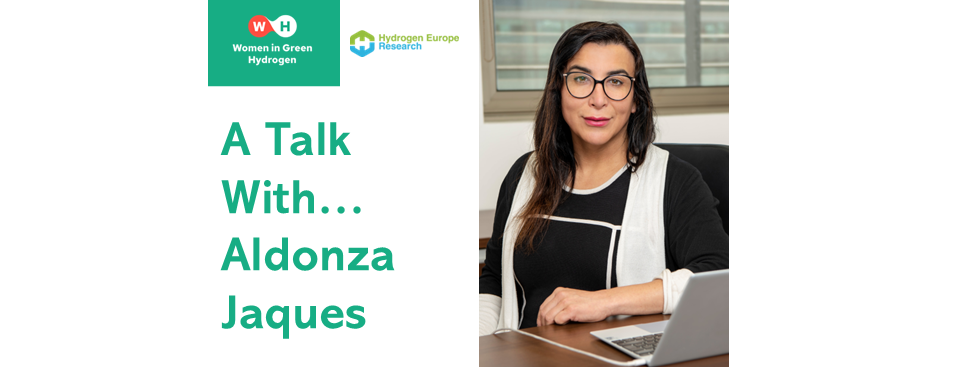
Introducing Aldonza Jaques
Aldonza Jaques is the Director of the Innovation Office for Academic, Chemical and Environmental Engineering at the Universidad Técnica Federico Santa María (UTFSM) in Chile. She studied Chemical Engineering there and obtained a Ph.D. in Metallurgical Engineering at the University of Nevada-Reno in 2009. She came back to Chile as a faculty member of the Department of Chemical and Environmental Engineering, specialized in the Diffusion and Mass Transfer Research Laboratory.
Her work also spans intellectual property strategies within research consortia and entrepreneurship ecosystems. As an expert in the field, she became Board Member of the Network of Technological Managers of Chile. She has also been identified as an Advisor for the Chilean National Institute of Patents and Intellectual Property with a focus on technology adoption to provide information for companies developing hydrogen transport, storage and production technologies.
What is the core issue your research work is trying to address, and what concrete advancement in the hydrogen sector (technical, methodological, and system-wide) does your research aim to enable? What role have you personally played in advancing this contribution?
Within the university, I focus on industrial applications and R&D since 2008. Hydrogen diffusion in steel and rapid detection of polymer integrity have been part of my research to ensure safe hydrogen usage. Conditions are tested for different materials. These resistance test include pressurized hydrogen injection, physical changes and permeation detection.
In collaboration with the Chilean government development agency (CORFO), this is the third year operating green hydrogen development programs fostering the adoption across industries: logistics, maritime transport, agriculture, and others. We have reached over 100 people trained in large industrial hubs of the country in Valparaíso, San Antonio and San Felipe-Los Andes.
Our next step is developing a micro credential or honors course for bachelor students, for which technology adoption in the industry would be key to enable real case studies and students to visualize concrete professional development opportunities.
What aspect of hydrogen research inspires you? And what potential do you envision for your country?
I was truly inspired as a professional and as a citizen the moment I realized Chile was going to build a green hydrogen strategy, surpassing political perspectives and different governments, requiring deep technical expertise to create a state policy.
The enablement of national technological advancement will allow us to move away from the natural resources provider business model into a manufacturing one, achieving full integration and adoption with special focus in industries with high impact such as copper mining and lithium extraction. These industries not only have high energy consumption due to processing capacity, but also a broad value chain and intensive information system network in continuous operation requiring solar power and battery energy storage systems (BESS).
Economic development must be accelerated by regional policy, including subsidies for the hydrogen economy, enabling long-term industrial planning. As a country we can have the potential to become electrolyzer and battery manufacturers. Supporting the installation of this manufacturing capacity depends on our vision to stabilize the production and begin a world class industry segment.
How do you think gender diversity impacts innovation in the hydrogen sector? What advice would you give to young women considering a career in hydrogen research or STEM fields in general?
As of my knowledge, diversity has been documented as generating positive impact based on cultural, ethical and educational backgrounds that leads to having different perspectives. Gender, specifically the low percentage of diversity in the sector, might have to do with the lack of visibility or proximity to role models. The importance of role models and mentorship in early stages of the careers cannot be overstated.
I would advise young women to connect with professionals in the field, to learn about the possibilities, and start thinking how they would picture themselves in the future, and what impact they would like to make in this society.
At UTFSM we believe that the usage of simple terms is key to untangle the chemistry behind the processes, so that the public can truly understand them, ensuring a true learning experience. We will also work on partnerships with the industry to provide hands on experiences, connecting hydrogen production and usage in our lessons.
In your opinion, how is Chile progressing in terms of STEM equality, and the university you are part of?
Chile has taken notable steps to reduce gender inequality in STEM by implementing targeted university admissions policies, and initiatives at early stages of education. Despite this progress, women still represent only about 25% of STEM enrollments in higher education, with particularly pronounced disparities in certain engineering fields.
Every year, we proudly recognise the first women engineer that ever graduated from this university in 1964, from the Chemical Engineering program. Together with the other program in my academic department, Environmental Engineering, this field has the highest representation of women among the engineering disciplines. As an institution the target is to achieve gender balance in other engineering disciplines, which will have a bright future with the high demand of professionals in Chile due to the energy transition.
At UTFSM we historically have programs installed for students with difficulty accessing the educational programs, by providing extra academic support. We have recently installed a gender policy, that aspires to increase female recruitment up to 30% and developed a permanence program. Acknowledging the fact that the desertion rate in the first year specifically is higher for women than for men, we have now a more balanced cohort during second up to graduation years. We also have intentionally incorporated more female professors, which have turned into role models for our students.
In addition, in the Innovation Office we have a hiring strategy which includes considering population groups which challenges in career development. This includes specifically women with young kids, which we acknowledge as a segment with a high challenge for employability worldwide. We are proud of our contribution and our results.