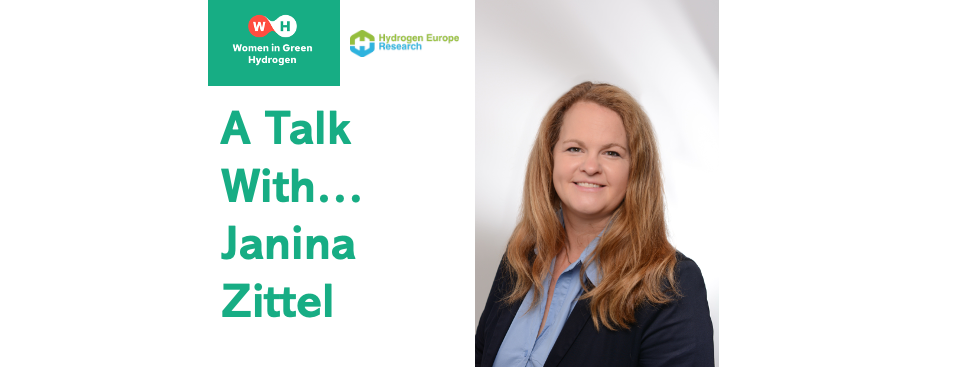
Jointly with our partner Hydrogen Europe Research, we are proud to present a series interviewing women in the green hydrogen sector.
Introducing Janina Zittel
Dr. Janina Zittel is Head of the EnergyLab of Research Campus MODAL at Zuse Institute Berlin and Deputy Head of the Applied Optimization department. With her team, she develops mathematical methods and software for the operation and planning of sustainable energy systems, from hydrogen pipelines and district heating networks to sector coupling, with a growing focus on large industrial consumers.
Her work bridges research and practice. Her team’s digital decision support for gas network operations was a finalist for the INFORMS IAAA award in 2020, and together with the gas transmission system operator Open Grid Europe, her team reached the final of the IIF Forecasting Practice Competition in 2025. She also serves on the Scientific Advisory Board of Foresight, the practitioner journal of the International Institute of Forecasters.
Janina came to optimization from climate science. She earned her doctorate in natural sciences at the Institute of Meteorology at Freie Universität Berlin in 2014, studying climate change commitment: the changes that would continue even if greenhouse gas concentrations were stabilized. That experience still drives her search for practical solutions for the energy transition.
Building bridges is a common thread in her work. She leads the topic group on modelling and solution strategies in the Germany Energy Research Network on Systems Analysis, strengthening exchange between mathematical methods and energy system planning. As a long-standing mentor in the Women in Green Hydrogen programme, she supports women on their way into technical and leadership roles.
Outside her research, Janina is active in local politics. For ten years, she has been a member of the Women’s Advisory Council on Urban Planning in Berlin-Mitte, helping to bring gender perspectives into urban development projects. She lives in Berlin with her family and loves running, slowly chipping away at her half-marathon times.
Can you briefly describe your role at Zuse Institute Berlin and the work you and your team do to support the transition towards sustainable energy systems?
At Zuse Institute Berlin, I develop and manage research projects in applied mathematics. The goal is to tackle the increasingly complex questions that arise in planning the energy transition with mathematical optimization tools. The problems we work on range from planning energy systems that supply cities with energy produced mainly in the surrounding region, to operating hydrogen pipelines, all the way to decarbonizing Western Europe’s largest district heating network, balancing several competing objectives under uncertainty about future prices and consumption. Of course, we can’t wait years for these problems to be solved, or burn more CO₂ in our computers than our solutions save. So we need smart algorithms that work in practical, everyday tools, and that’s exactly what we focus on.
What inspired you to pursue a career in scientific research, and what led you from meteorology and climate modelling to mathematical optimisation and sustainable energy systems? What excites you most about your work today?
I’m always most motivated when I’m working on questions that can’t be answered straightforwardly. In my PhD, I studied climate change commitment: which effects continue even if we stabilize greenhouse gas concentrations, for example, in sea level, vegetation zones, and Arctic and Antarctic sea ice. Without wanting to paint too bleak a picture, engaging so deeply with these questions is hugely motivating to work on solutions that get the rise under control as early as possible. And that’s exactly what I can do in applied mathematics. We help decision-makers plan fossil-free energy systems in a way that keeps consumer prices from rising unnecessarily, while also thinking about efficient operation and security of supply.
What I find particularly exciting is developing new projects together with our national and international research and industry partners. Our methods have to keep pace with the growing complexity of the questions, so we always need to think three steps ahead of the problems the energy sector faces day to day. For example, we were already working on a decision-support tool for operating hydrogen transport long before plans for a large-scale network like the European Hydrogen Backbone took shape.
What is the core challenge your research aims to address, and how can mathematical optimisation help us design more efficient and sustainable energy systems?
With the electrification of many consumers (heat pumps for heating, electric mobility and more), the sectors of the energy system are becoming increasingly interdependent. That makes it harder to find the optimal system design, yet it’s essential for making these systems more sustainable, since this coupling holds enormous potential. Synthetic fuels, for instance, can store surplus renewable energy in chemical form for times when it’s needed. Together with Freie Universität Berlin, we are also researching a liquid that can store chlorine safely. Chlorine is a key base chemical for industry, and producing it takes a lot of electricity. Safe storage could allow production to be decoupled in time from its use in subsequent chemical processes, helping to make better use of fluctuating renewable generation. To unlock this potential, we can no longer optimize each system on its own. We have to look at the whole picture, with all its options. Mathematically speaking, that’s a combinatorial explosion, and taming it calls for innovative methods.
As electricity, gas, heat, and hydrogen systems become increasingly interconnected, what role can hydrogen play in the energy transition? What are the main challenges in integrating hydrogen into these complex systems?
Hydrogen is another link between the sectors. It can transport and store energy far more densely than electricity, which makes it a great solution for the fluctuating power generation from wind and sun. The price is the losses during production and when converting it back into electricity in fuel cells. Hydrogen can also fuel gas-fired power plants for our heating networks, heavy-duty vehicles, or steel production. In our own work, we asked what changes in controlling a pipeline network when it carries hydrogen instead of natural gas. The answer: it has to be operated far more dynamically. We also explored blending hydrogen into the natural gas grid as a reliable buyer while the market ramps up. Today, though, few would want to pour champagne into the water like that, as green hydrogen is simply too valuable. Import strategies, local production, and the market framework are all still open questions, and mathematical decision-support tools can help answer them.
You mentioned that when you joined your research team you were the only woman. Since then, the team has progressed towards gender balance, with women represented at different levels, including research group leadership. What do you think made this change possible, and what lessons could other research organisations learn from your experience?
Beyond basics like work-life balance, family-friendliness and job security (which are rarely a given), what made the difference for me was a line manager who was open to me questioning the status quo and driving change, both in research topics and in staffing. With that backing, I’ve had the pleasure of accompanying wonderful women for 12 years, and along the way we’ve become more international. Role models matter: women are more likely to apply to a group led by a woman. And how does it feel to introduce yourself to a team, only to find a room full of men? Many women lack the confidence to highlight their strengths, so it takes a careful look at applications. A note on quotas: nobody wants to get hired because of her gender. In practice, though, the few women end up on every committee to represent women, leaving little time for their scientific work. As long as the ratio is this skewed, quotas benefit everyone. With equal qualifications, the claim that a woman got a job “only” because of a quota simply doesn’t hold. It usually comes from those who didn’t get it. Finally, trust women with challenging tasks so they can grow.
How can mentorship help women navigate their careers in scientific research and the hydrogen sector? Based on your experience with the WiGH mentorship programme, what advice would you give to women considering becoming mentors or mentees?
In a highly technical field like hydrogen, there aren’t many women you can share experiences with, particularly in leadership roles. And would we even dare to ask for advice? The challenges we face, beyond what men experience, can feel overwhelming, and with direct colleagues, competition plays a role too. Structured mentorship programmes break down exactly these barriers: your mentor is there to be asked, and since she’s outside your organisation, there’s no competition.
I’m currently on my third mentoring journey with Women in Green Hydrogen. I bring not only my professional experience but also my perspective as a mother and a woman with over 40 years of life experience. My mentees have great motivation, talent, and commitment, but also doubts about whether they can withstand the headwinds. Discussing challenges I’ve already faced, such as daring to start over in a new field, reminds me of my younger self and helps me understand my own team better. My advice: look for a programme that suits you, but also dare to approach inspiring women and ask if they’d take the time to talk with you. I didn’t wait for the next programme. I went out and grabbed my own mentors.